At the heart of all effective Search and Rescue (SAR) operations lies the principle of command and control: the systematic management of personnel, resources, information, and decision-making processes. In the face of high-stress, time-sensitive, and often dangerous conditions, robust command and control structures are indispensable to the success of any SAR mission.
The Foundation of Command and Control
Command and control (C2) refers to the exercise of authority and direction by a properly designated commander over assigned and attached forces in the accomplishment of a mission. In the SAR context, it encompasses the ability to plan, direct, coordinate, and monitor the activities of a diverse group of responders, including Arizona Department of Public Safety (DPS), Forest Service, Bureau of Land Management (BLM), local law enforcement and first responder, other counties’ SAR organizations, and sometimes volunteers.
- Command: The authority vested an individual or group to make decisions and allocate resources.
- Control: The process of ensuring that orders and plans are effectively implemented and adjusted as necessary.
A well-structured C2 system enables leaders to maintain situational awareness, prioritize tasks, manage resources, and adapt to evolving conditions. It reduces confusion, duplication of effort, and the potential for error ensuring that the focus remains on rescuing individuals and safeguarding responders
Elements of Command and Control in SAR
Incident Command System (ICS)
The Incident Command System is an internationally recognized framework for managing emergencies of all sizes. It provides a standardized hierarchy, terminology, and set of procedures that enable diverse agencies and organizations to work together effectively.
Key features of the ICS include:
- Modular organization: The structure can expand or contract as the incident evolves.
- Unified command: Multiple agencies can share responsibility for overall management.
- Clear roles: Defined positions such as Incident Commander, Operations Section Chief, Logistics, Planning, and Finance.
- Span of control: Leaders should manage only a reasonable number of personnel (typically 3-7) to ensure effectiveness.
ICS will be covered in more detail below.
Decision-Making and Resource Allocation
SAR operations often unfold in environments of uncertainty, where leaders must make decisions with incomplete information. Effective command and control require processes for:
- Rapidly assessing evolving risks and hazards.
- Prioritizing objectives, such as life safety, incident stabilization, and property conservation.
- Allocating resources (personnel, equipment, and supplies) where they are most needed.
- Delegating tasks and synchronizing the efforts of multiple teams.
Situational Awareness and Information Management
Maintaining a comprehensive picture of the operational environment is vital. Graham County Search and Rescue use SAR Topo for the situational awareness picture. A detailed study of SAR Topo as it is used by GCSAR is below.
Planning and Deployment
With a command structure in place, leaders:
- Develop an incident action plan, outlining priorities and strategies.
- Assign tasks and allocate resources to search sectors or operational areas.
- Establish communication protocols and reporting schedules.
- Coordinate with supporting agencies and volunteers.
Execution and Adaptation
During active operations, command and control must be dynamic:
- Monitor progress and update plans as new information emerges.
- Manage personnel safety and welfare.
- Adapt tactics to changing weather, terrain, or hazard conditions.
- Communicate with stakeholders, including families of missing subjects.
Challenges to Effective Command and Control
Even with sound structures and practices, SAR operations often face obstacles, such as:
- Interoperability: Differing equipment, protocols, and languages can hinder cooperation.
- Resource limitations: Insufficient personnel, equipment, or funding may constrain operations.
- Information overload: Floods of data can make it difficult to identify critical updates.
- Environmental hazards: Remote locations, extreme weather, or ongoing dangers may put responders at risk.
Addressing these challenges requires regular joint exercises, investment in training and technology, and proactive relationship-building among agencies.
The OODA Loop
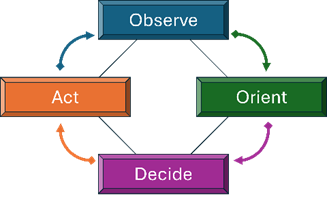
The OODA loop—Observe, Orient, Decide, and Act—is a dynamic decision-making framework widely used in SAR operations. Teams begin by observing the environment, gathering real-time information about terrain, weather, and clues related to the missing person. Next, they orient themselves by analyzing the data, considering past cases, and updating their understanding of the situation.
Once oriented, SAR teams decide on the best course of action, such as choosing search patterns or allocating resources. Finally, they act by executing their plan and continuously cycling through the OODA loop as new information emerges. This iterative process enables responders to adapt quickly, improving the likelihood of a successful outcome in unpredictable wilderness environments.
Benefits of the OODA Loop are increased speed and adaptability. Increased speed enables faster, more effective reactions to a continuously changing mission. Adaptability: the continuous, repetitive nature of the loop allows for constant refinement and agility as new information is received.
Leadership
Effective command and control depend not only on systems, but on people. Leadership in SAR operations requires decisiveness, clear communication, empathy, and the ability to inspire and coordinate teams under duress. Training, mentorship, and psychological support for leaders and responders are essential to maintaining performance throughout an incident.
Search and Rescue (SAR) leadership roles require a blend of technical skills, leadership qualities, and a commitment to safety and efficiency. Leaders must possess knowledge of search strategies, rescue techniques, and incident command systems, as well as the ability to manage teams, make sound decisions under pressure, and effectively communicate with diverse stakeholders.
Key Leadership Requirements in SAR:
- Technical Proficiency: A solid understanding of search and rescue techniques, including ground search, rope rescue, and swift water rescue is essential.
- Incident Command System (ICS) Knowledge: Familiarity with ICS principles and roles is crucial for coordinating multi-agency responses.
- Leadership and Management Skills: SAR leaders need to be able to motivate teams, delegate tasks, and ensure effective communication and coordination.
- Situational Awareness and Decision-Making: The ability to quickly assess situations, identify risks, and make informed decisions under pressure is paramount.
- Communication and Interpersonal Skills: SAR leaders must be able to communicate effectively with team members, other agencies, and the public.
- Commitment to Safety: Prioritizing the safety of rescuers and subjects is a fundamental responsibility.
- Physical and Mental Fitness: SAR operations can be physically demanding and mentally challenging, requiring a high level of fitness and resilience.
- Knowledge of Equipment and Technology: Understanding the capabilities and limitations of SAR equipment and technology is important for effective operations.
- Understanding of Search Theory: SAR leaders need to know how to effectively plan and execute searches, including understanding probability of detection and victim behavior.
- Awareness of Hazards: Knowledge of the hazards associated with different search environments (e.g., urban, wilderness, vertical) is crucial for safety.
- Supervisory and Personnel Management Skills: The ability to effectively supervise and manage personnel, including task assignments, training, and performance evaluation, is essential.
Further Discussion
Under Construction
In describing effective command and control it is useful to divide the skills and knowledge needed into smaller subjects:
- Callout Procedures: Standardized callout procedures enable fast, coordinated SAR mobilization, improving safety and effectiveness for all participants.
- Deployment:
- Demobilization:
- SAR Topo: SAR Topo, a specialized mapping and tactical planning tool, has SAR operations by offering advanced features tailored to the complex needs of rescuers and planners. Born out of the necessity for clear, dynamic mapping in emergency situations, SAR Topo provides real-time data visualization, efficient coordination, and a repository for mission-critical information.
- Briefings:
- Interaction with Outside Entities:
- Incident Command System: